Table of Contents
In today’s online world, every business wants more customers and more sales. But many online stores forget about an important group of people — customers with disabilities. If someone cannot read your content, use your menu, or complete checkout easily, they will leave your website. This is where Ecommerce Accessibility becomes important.
Ecommerce Accessibility means designing your online store so everyone, including people with visual, hearing, physical, or learning challenges, can use it without difficulty. When your website is accessible, it becomes easier, faster, and more user-friendly for all visitors — not just those with disabilities. Simply put, improving Ecommerce Accessibility is not just about rules or compliance; it is a smart way to grow your audience, increase trust, and boost your sales.
How Ecommerce Accessibility Benefits Your Online Business?
Many businesses view accessibility as an expense. However, it’s actually an investment with substantial returns. When you design for all, you open your store to a massive, underserved market.
- Expand Your Customer Base: Over one billion people worldwide live with some form of disability. Specifically, this represents a significant purchasing power often overlooked by non-accessible sites. By removing barriers, you directly invite these customers to your store.
- Boost Your Brand Reputation: Companies committed to inclusivity earn trust and loyalty. Consequently, an accessible website signals a socially responsible brand, appealing to a wider audience.
- Improve SEO: Many accessibility best practices overlap with good SEO. For example, clear headings, proper image alt text, and logical navigation benefit both users with screen readers and search engine crawlers. Thus, an accessible site can improve your rankings.
- Reduce Legal Risks: Accessibility laws, like the Americans with Disabilities Act (ADA) in the U.S., are increasingly being applied to websites. Therefore, an accessible site helps you avoid costly lawsuits and ensures compliance.
- Enhance Overall User Experience (UX): What helps one group often helps all. For instance, clear navigation and high-contrast text benefit everyone, not just those with visual impairments.
Tips to Create an Accessible Online Store for Disabled Customers
Achieving accessibility involves a multi-faceted approach. It requires thoughtful design and careful implementation across various elements of your ecommerce platform. Here are the ways that make your store perfect for disabled customers. Make ecommerce accessible for all.
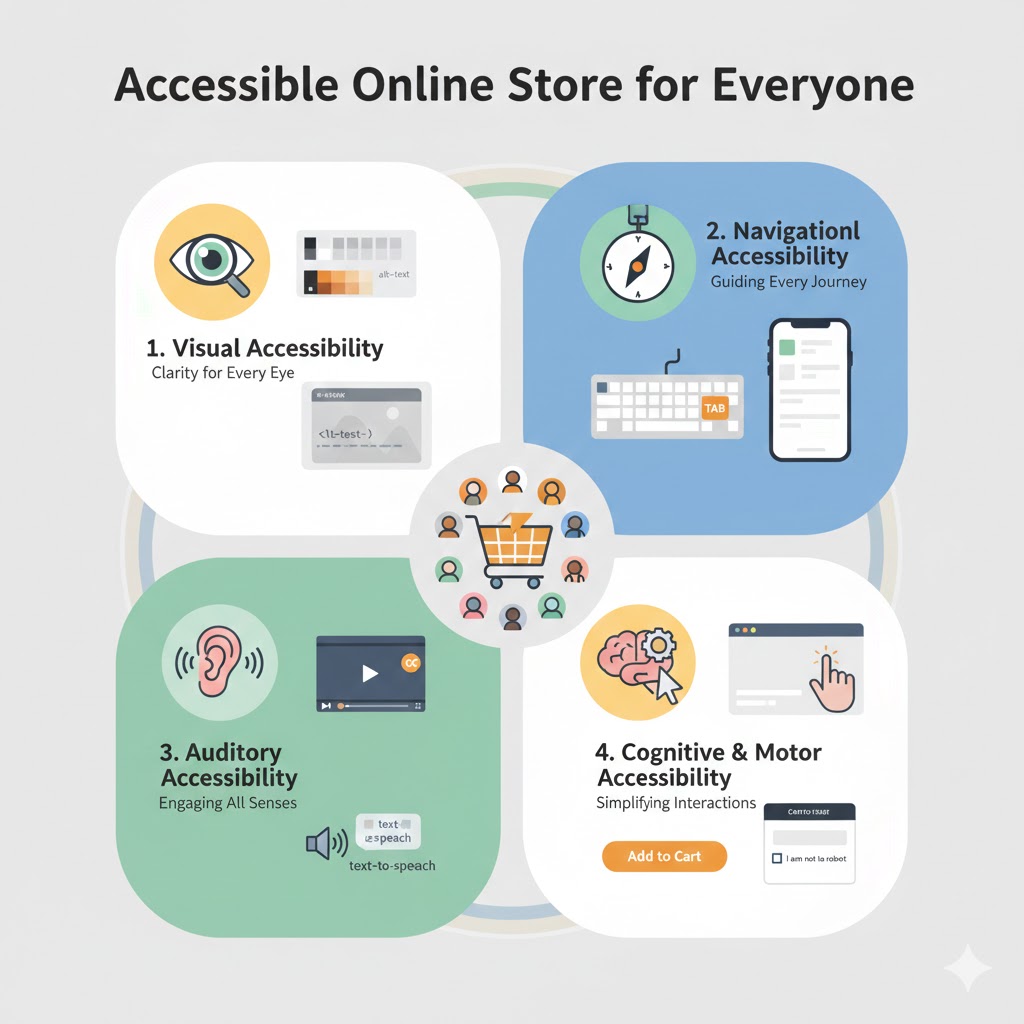
1. Visual Accessibility: Ensuring Clarity for Every Eye
Visual impairments affect how users perceive your site. You must ensure your visual content is clear and adaptable.
- High-Contrast Text: Ensure sufficient color contrast between text and its background. Tools like WebAIM’s Contrast Checker help verify compliance. Ultimately, this makes your content readable for users with low vision.
- Resizable Text: Allow users to easily adjust text size without breaking the layout. Consequently, individuals with partial sight can customize their viewing experience.
- Meaningful Alt Text for Images: Every product image and graphic needs descriptive alternative (alt) text. Thus, screen readers can describe the image to visually impaired users, providing crucial context.
- Focus Indicators: Make sure keyboard focus is always visible. Therefore, users navigating with a keyboard can easily see where they are on the page.
2. Navigational Accessibility: Guiding Every Journey
Not all users navigate with a mouse. Many rely on keyboards, screen readers, or other assistive technologies. Your site must be navigable without a mouse.
- Keyboard Navigability: Ensure all interactive elements (links, buttons, form fields) are accessible via keyboard. Specifically, users should be able to tab through your site in a logical order.
- Clear and Consistent Navigation: Use intuitive menus and a consistent site structure. Consequently, users can predict where to find information, reducing confusion.
- Descriptive Link Text: Avoid generic “click here” links. Instead, use descriptive text that explains the link’s destination. This helps screen reader users understand the context without clicking.
- Skip-to-Content Links: Provide a “skip to main content” link at the top of your page. Therefore, keyboard users can bypass repetitive navigation elements quickly.
3. Auditory Accessibility: Engaging All Senses
For users with hearing impairments, any auditory content must also have visual alternatives.
- Captions and Transcripts for Videos: All video content, especially product demonstrations, must include accurate captions. Additionally, provide full text transcripts for downloadable content.
- Avoid Auto-Playing Audio: Never have audio play automatically. Ultimately, this can be disruptive and disorienting for many users, including those using screen readers.
4. Cognitive & Motor Accessibility: Simplifying Interactions
Users with cognitive disabilities or motor skill limitations benefit from simplicity and flexibility.
- Simple and Clear Language: Use plain language and avoid jargon. Specifically, write clear, concise product descriptions and instructions.
- Predictable Layouts: Maintain a consistent and predictable layout across your site. Therefore, users can learn and navigate your site more easily.
- Flexible Forms: Design forms that are easy to fill out. For example, provide clear error messages and offer auto-fill options where possible.
- Sufficient Time Limits: Avoid strict time limits for completing tasks like checkout. Consequently, users with slower processing speeds or motor limitations have ample time to complete their purchases.
Conclusion: Your Inclusive Path to E-commerce Success
Embracing ecommerce accessibility is more than just following rules; it’s about building a better, more inclusive online store for everyone. By implementing these practices, you not only open your business to a vast, underserved market but also significantly enhance your brand reputation, improve your SEO, and create a superior user experience for all your customers. The digital world should be accessible to everyone, and your e-commerce store has the power to lead the way.
If you need expert guidance to emotional design to shape online business journey or redesign your ecommerce platform to ensure accessibility for all users, do not hesitate to reach out. We (WC Booster Team) can help you build an online store that truly serves everyone.